
Flexible fastening system
In spite of the fastening components providing certain flexibility to GEO fastening system, its biggest disadvantage is still its relative stiffness as compared to flexible fastening systems. Furthermore, GEO fastenings need to be checked frequently for clamping strength, the nuts on the bolts need to get repeatedly tightened and the spring washers frequently break and require replacement. All that track maintenance work is too labour-consuming and expensive.
That is why the stiff clamp plates and the frequently breaking double spring washers are increasingly substituted by flexible tension clamps of special shape, made of spring steel. In Hungary SKL-3 tension clamps are mainly used to substitute clamp plates in the GEO type fastenings.
The flexible rail fastening system is generally based on the use of flexible tension clamps made of spring steel. The rail is fixed to the concrete sleeper by flexible tension clamps which are fastened by sleeper screws. The concrete sleepers have holes lined with plastic dowels to receive the sleeper screws and keep them tight. Base plates are no longer used with modern pre-stressed concrete sleepers, as the sleeper itself is moulded to the required shape.
The flexible fastening system based on tension clamps, has the following components: tension clamp fixing the rail to the concrete sleeper, sleeper screw equipped with flat washer fastening the tension clamp, angle guide sitting in the trough shaped in the concrete sleeper and supporting the tension clamp, and plastic dowel inserted into the receiving holes for the sleeper screws in the concrete sleeper. In Hungary the most commonly used flexible fastening system is based on the tension clamp model SKL-14 designed originally by Vossloh AG.
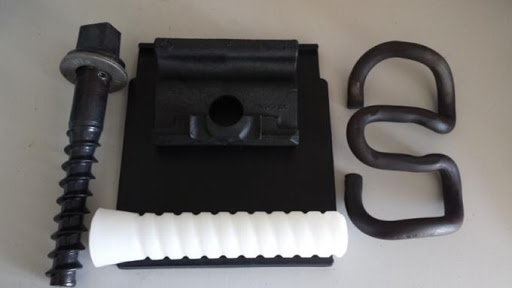

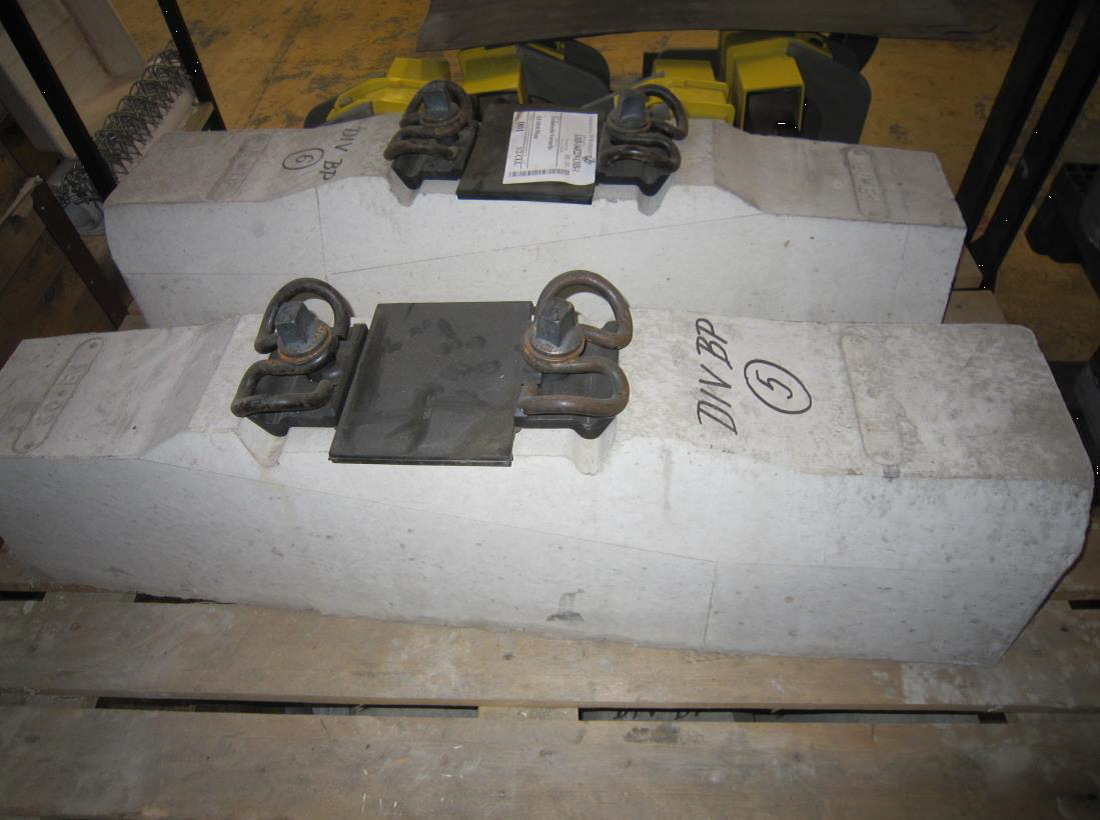
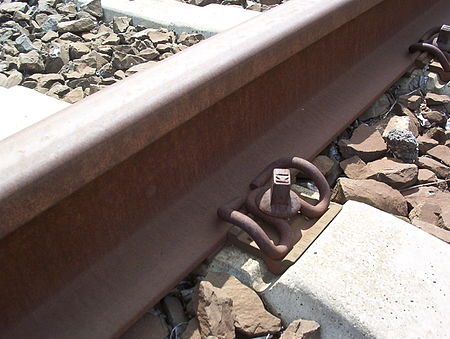
on 2,6 m LW concrete sleeper
Main characteristics of W14 rail fastening system:
| General Field of Application | High Speed & Conventional Ballasted Track |
|---|---|
| Axle Load | ≤ 26 t |
| Speed | HS; ≥250 km/h // CR; ≤ 250 km/h |
| Curve Radius | HS; ≥400 m // CR; ≥ 150 m |
| Height Adjustment | Optional |
| Gauge Adjustment | ± 10 mm |
| Vertical Fatigue Strength SKL 14 | 2 mm |
| Static Stiffness (Rail Pad) | ≥ 50 kN/mm EN 13146-9 |
| Toe Load | 9 kN EN 13146-7 |
| Electrical Resistance | ≥ 5 kΩ EN 13146-5 |
| Rail Creep Resistance | ≥ 9 kN EN 13146-1 |
| System Approval | EN 13481-2 |